Sunday, October 21, 2012

Our visit Ankarana Park- By Emily


It was six o'clock in the morning and the sun had just risen. Mom, Dad, and I were taken to shore by Peter in his dingy. We said goodbye to our boat Emily Grace which was rafted next to Peter's boat Lovina. Once ashore, we took a taxi from Crater Bay to Hellville were we met up with the family from Mojumbo. From there we all took a fast ferry boat to Ankify. We were on our way to Ankarana Park in Madagascar. 


We waited in Ankify for Michelle who was going to drive us to our destination. Mojumbo, who was traveling with us, was a family of two adults and two kids. The parents were Vicki and Gary, while the kids were ten year old Nina and twelve year old Zeke. I kept everyone amused by making difficult origami, and Michelle finally arrived. The taxi-brousse wasn't very big, and when we left there were nineteen people plus a family of chickens behind my seat. It was a scenic, if bumpy, van ride, and once we even forded a river! The locals had made the water semi shallower by stacking a lot of rocks there, but there were still several inches of water under our tires. We watched villages at regular intervals with colorful markets, people walking zebu, and large rice patties and grazing fields. Halfway there we drank a free soda out of glass Coke bottles, typical of the 1950s. We drove through a village and one of the men in the van threw biscuits for the kids. They yelled and ran for the biscuits he threw to them, and it was like a race to be the first one there. Dad bought a bunch of fresh roasted cashews on the side of the road and we ate some of them on the way. After three hours of being jammed next to a fuel jug I was relieved when we arrived at our lodge.


After lunch we went on a tour with our guides Joachim and Simon. We weren't even in the park yet when Joachim said, "Ok, there is a chameleon within a two meter radius." Sure enough, there was. A big male chameleon, about 1 foot long, stood on a branch. Its alien eyes swiveled independently to lock each one of us in its gaze. The next creature we saw was also a chameleon, although this one was a Panther chameleon, the most colorful of all the 71 types of chameleon. We entered the park and a harrier hawk swooped above to welcome us. There were many green geckos, and they were quite pretty to see. Joachim showed us trees including the Sardia tree used for making canoes, Rosewood, and Sandalwood.


After a while we arrived at a cave and we donned our headlights. Great stalactites and stalagmites rose from the floor and ceiling. Bats flew round and filled the air with their high-pitched voices. When we exited, night had fallen and we got to see the forest at night. We saw a leaf gecko and the eye-shines of many animals, including a crowned lemur.


When we got back we explored the workings of our very basic lodging, and declared it... Interesting. There was a double bed on the ground floor with a shower and toilet, and there was a foam mattress in the loft above. There was a generator that ran from dusk to ten and that activated one light bulb hanging on the loft railing, other then that, no light except lanterns. But that was well with us because we were tired and fell right asleep as early as we could. There was no running water, but Simon had brought us buckets of water from the well. The toilet flushed by quickly dumping in water, and the shower was a bucket of freezing water that you poured over your head with a dipper. The beds were covered by mosquito nets and the pillows were filled with the natural kapok. We felt right at home on the very lumpy stuff that was used to make lifejackets. At three in the morning we were woken by the roosters, and we longed for the quiet nights on the boat.


The next day we woke early to have breakfast and set out at a leisurely pace. Birds called out and presented themselves one by one. We saw the Crested Drongo, Creole Bird, Greater Vassok parrot, and the Crested Cua. We saw a few Crowned Lemurs, still groggy, resting on a branch. We saw leaf bugs, which are so strange I can barely describe them. The young look like ticks with white fluff on their backs, but the adults were green moths. We saw more trees too; the Fikias tree (Which was huge!), a bottle vine (likewise big), and a sunburn tree that had a reddish, peeling bark. We got to the lookout point and admired the view of the forest and the Tsingy rock. Joachim showed us another leaf gecko with its weird, flat look, and we saw a long thin snake that Zeke had spotted. We got back to the lodge at lunchtime with the rest of the day to relax.


The last day of our stay was the longest. Nina, Zeke, and I were thankful for the car ride to the park entrance while the parents walked. When they arrived we started out with a couple other people. We saw a Crocodile Gecko to begin our hike and a big baobab with a trunk that had a 1 meter circumference. Our guide told us that a baobab was one hundred years old for every meter of circumference. The trail eventually left the forest and took the track of a dry riverbed. Joachim explained to us the water level could reach over ten meters high in the rainy season, and showed us a sinkhole that marked the entrance of an underground river. The underground river would carry the water away and come to the surface three hundred meters before the ocean. We also found fossils of shells in the rock.


We entered the woods again and saw a deadly bug. What was it? A scorpion. Simon lifted a couple of rocks, and there it was. After a few photos we moved on and saw a few more birds we hadn't seen, like the Magpie robin, Blue Vanger, and the Paradise Fly Catcher. The male paradise fly catcher had a blue back and a long white tail. The female was brownish red and didn't even look like she was the same species. Later we found two of Sanford's Brown Lemurs lying on a branch above us, regarding us with a bored expression. The female was gray, but the male had a white ruff around his face. Joachim explained that there were normally seven to fourteen in a group, so the others were sure to be nearby. Shortly after that we saw a Sportive Lemur snuggled up in the hollow of a tree. He was surprisingly smaller than the other lemurs we had seen, though his eyes were big and round.


Suddenly and abruptly the landscape changed from trees and leaves to sharp pointy rock formations. Gray, thorny plants and elephant Baobab were the most common plants we saw. We had arrived at the tsingy rock. Our guide showed us an ebony tree and a sun bird, which was small with a shiny blue back. Finally we reached our destination: Point suspendu, the suspension bridge. It was a simple suspension bridge, and we all went over it, one at a time, to have a snack on the other side. Zeke, Nina, and I had fun pointing out the dinosaur-shaped tsingy rock to the adults. Eventually we crossed back over and retraced our steps. On our way to lunch, Joachim showed us a huge 400 year old baobab, about four or five meters in circumference and very high.


Now, my favorite event that day was lunch. No, not the food, I liked the lemurs that tried to steal our food. As soon as we sat down and the containers were out, crowned lemurs started gathering around us. They perched on the wood that supported the roof over the eating place and waited for the banana desert that was sure to come. When the bananas were put on the plates we had to hide them behind napkins to keep the lemurs off. After our meal I delighted in watching the lemurs leaping from tree to tree as they departed.


Next morning we left, and went back to our boat. I must say that Ankarana Park was a wonderful place to see the wildlife of Madagascar.  Enjoy the video of some of the highlights of our trip.


Emily


Monday, August 20, 2012

Mayotte


Pirate attacks have been mainly north of Mayotte, but we were still concerned.  We timed our departure so that we spent most of our time offshore in the relative protection of darkness.  We ran without AIS, running lights and only used RADAR sporadically.  We saw no other vessels and had calm winds and seas.  We entered through the Bandrele pass on the southeast side of Mayotte and entered without any dramas.  The pass was well-marked with real navaids and range towers.

There are two main islands in Mayotte: Grande Terre and Petite Terre. On Petite Terre are the capital Dzaoudzi and the airport. After anchoring there in over 60 feet, we landed at a real floating dingy dock and walked around doing the check-in formalities.  Other than the nominal fare for a cab ride to the customs office at the airport and about 3 hours of time, we completed the FREE paperwork good for about 3 months.  We then walked over to the local yacht club for a cold beer and to get some local info.  We met Franck, the current commodore, who spoke good English, gave us a warm welcome and offered temporary membership as a ‟passant‟ enabling us to make use of the facilities, such as the bar and the washing machines.  More importantly, he gave us the password for free internet and pointed us to a free mooring to use for most of our stay.  


After 2 nights swinging around on 240 feet of chain, we moved over to the mooring and it held well during a couple of 20 knot blows.  Franck lives on his boat Peerliane that he built and we saw him sailing around a couple of times during our stay.


We took the ferry (le Barge) from Dzaoudzi to Mamoudzou on Grande Terre, where all the shops are. The ferry was free going over and about $1 each for the return trip. Everything is priced in Euros here and we quickly exercised our credit card to get a pocketful of those.  Mamoudzou is a curious mixture of dilapidated buildings and roads, with much building still in progress.


Mayotte is a mixture of locals (mainly black Muslims) and expatriate French. We found most people to be very friendly and helpful. The locals are mostly rather poor, while most of the French seem to be fairly well off.  We found the stores fairly well-stocked and the DHL service was expensive but reliable.  In addition to "normal" grocery stores, there were open markets everywhere.  We got our first DHL delivery so easily, we ordered a few more items as well.


While waiting for our parts we circumnavigated Mayotte and explored the surrounding reefs. Much of the coral had been damaged by bleaching and crown-of-thorns starfish, of which there were still a few around, but overall the reefs seem to be recovering. There was one particularly interesting site the so-called “La Passe en S”, an S-shaped entrance through the reef into the lagoon. This national park has some really stunning dive and snorkel sites in crystal clear water.  We snorkeled twice but never saw the enormous turtles that reportedly live here.


We visited Le Jardin MaorĂ©, a resort near Ngouja and enjoyed the nice beach, the massive baobab trees and a $190 lunch.  Most locals snorkel here to see the turtles and we saw several as we approached in our dingy.


Baobab is the common name of a genus (Adansonia) containing eight species of trees, native to Madagascar (having six species), mainland Africa and Australia (one species in each).This tree is the National Tree of Madagascar and we saw several there too.

Other common names include boab,  boaboa,  bottle tree, the tree of life, upside-down tree, and monkey bread tree. The species reach heights of 98 ft and trunk diameters of 23 to 36 ft.  Its trunk can hold up to 120,000 litres of water.

The Baobab Tree is also known as the tree of life, with good reason. It can provide shelter, clothing, food, and water for the animal and human inhabitants of the Savannah regions. The cork-like bark and huge stem are fire resistant and are used for making cloth and rope. The leaves are used as condiments and medicines. The fruit, called "monkey bread", is edible, and full of Vitamin C. The trees’ stored water is tapped during dry periods.  Mature trees are usually hollow, providing living space for many animals and humans. Radio-carbon dating has measured that age of some Baobab trees at over 2,000 years old. For most of the year, the tree is leafless, and looks very much like it has its roots sticking up in the air.


Next we went to Soulou were we found a 30 foot waterfall that we could see right from our anchor spot.  This was nice since most falls lie deep inland requiring a 2-3 hour hike.  This one dumped cool fresh water almost right on the beach and it flowed out into the warmer harbor.  We brought the dhow ashore that Emily had been building for its maiden voyage.  She set it down and it took off with the wind.  Despite no rudder, she ran remarkably straight.  She also leaked a little bit and while authentic, dad may add some epoxy sealer later to fix that.


Our next stop was the Choazil Islands which are exposed to the north but beautiful.  Two small islands connected with a white sand beach and surrounded by clear blue water.  We were not the first to discover it, since just after we dropped the hook, 2 small day boats motored up to drop off about 12 sunburned white folks.  Oh well, they only stayed about an hour and we were left alone for the rest of our stay on the beach.


In the afternoon, winds switched to North and picked up and the captain decided to head for a more protected anchorage.  We checked out another but found it too deep and still exposed, so we motored all the way back to our free mooring in Dzaoudzi and arrived just at dusk.

We managed the 3 mile trip from Dzaoudzito to M'Bouzi island in our dingy to see some protected brown lemurs that originally came from Madagascar.  We arrived at the same time as the park rangers and helped carry jugs of fresh drinking water for the 2000 lemurs that roam this small island.  We fed them some bananas that we brought and toured the rustic buildings.  Many of the lemurs had some skin disease that made their tails look ratty.  They used to charge for visitors but we were not asked for any money and they seemed happy for our help carrying water and bananas.  We only stayed a short while and buzzed back to the mother ship.


We spent considerable time trying to get duty free diesel, but were hampered by the Ramadan holiday and French officials that spent little time in their offices. Apparently, we are the first cruising boat EVER to request duty free fuel in the history of Mayotte.  Eventually we were told duty free only applied to commercial boats so we opted not to get fuel that was more expensive than available in Madagascar.  We did, however, enjoy the variety of the French dingys in the anchorage.


All considered, we enjoyed our stay in Mayotte.  We fixed the major items (a cooling problem on the outboard, a leaky dive cylinder valve, a broken dive computer and depth gage) and had mailed in some marine parts that we were unlikely to find, even in Africa.  So with most systems up and running well again, we head back to see a little more of Madagascar.  Come along, Dear reader and enjoy that with us.
Tom

Sunday, August 19, 2012

The building of the Sailing Yacht Sea Dragon


The outrigger canoe dhow is present in parts of the Indian Ocean including, East Africa, Comoro Islands the Maldives and parts of India which are substantially older cultures than that of Oceania and so some would speculate that the outrigger canoe may have its origins in this region.


However many believe that the outrigger canoe in whatever form it first appeared, originated in the region of Indonesia, spreading outwards with the migration of these people across into Samoa, (the birthplace of Polynesian culture) and also to Micronesia and Melanesia.


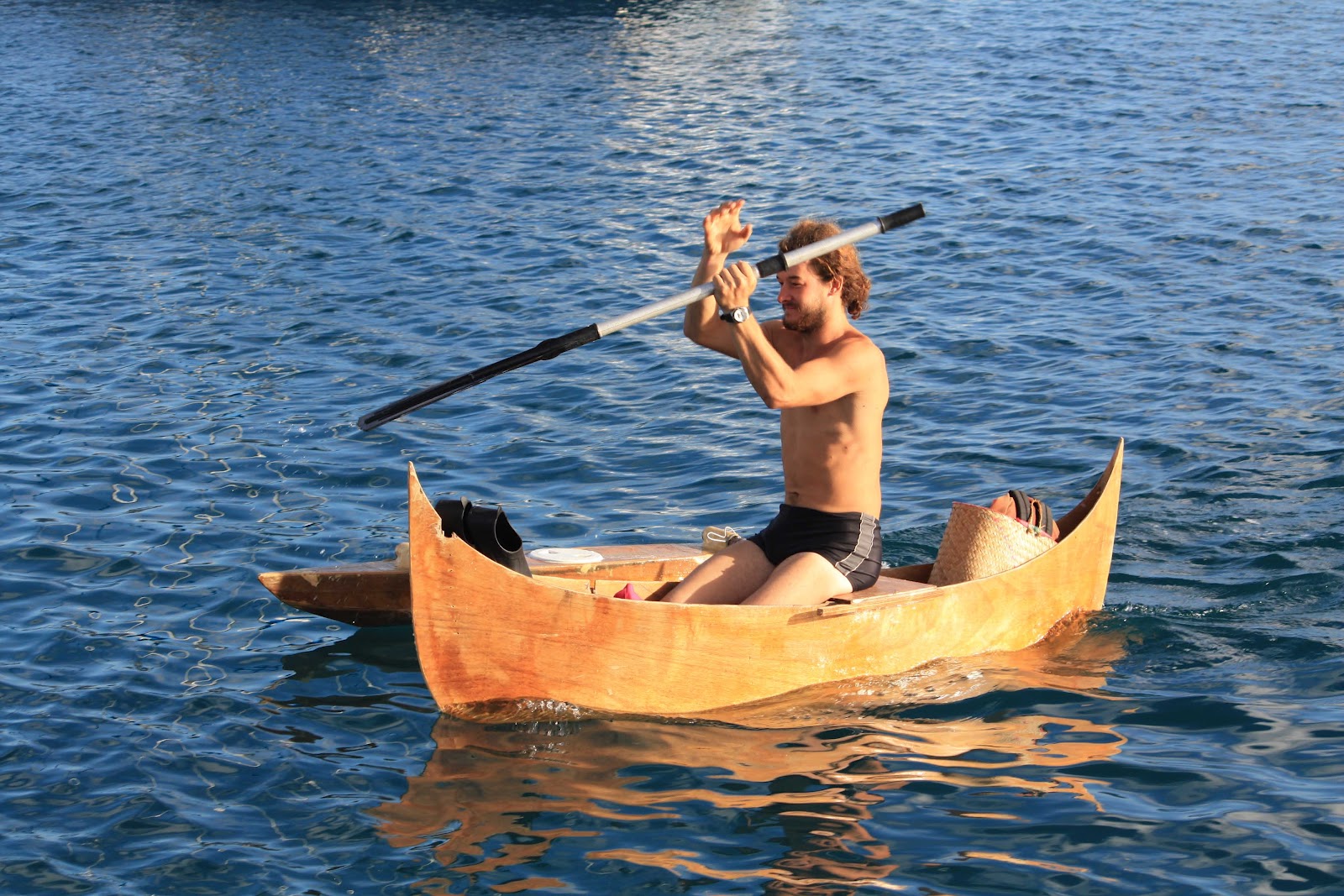
Shipbuilding must run in the family.  While Emily has not yet started designing nuclear submarines like her dad, she has been honing her skills by making a local craft.  The project started when we found a canoe hull and outrigger parts in the tide line on  a beach.   We have been looking closely at the dhows as they sail and/or paddle by and have been gathering details to make the parts that were missing. Emily has her own knife and whittled and carved and gouged and sanded away at some local wood and branches.

 
Outriggers provide stability to the narrow hollow log dugout which would otherwise roll over in the water.  They consist of one or more booms tied across the dugout.  To the boom ends are fixed connectives and they, in turn, are attached to the outrigger floats.  The outriggers floats are fixed to poles and are attached to the hull usually by rope bindings. The single outrigger canoe has a substantial float set out on one side only.  This float is always kept on the windward side – a sort of counterpoise.

 
Here you see how a real boom is tied (left) and how ours came out (right).

Here you see the joints fitting a real float (left) and how ours came out (right).


Emily wove the small palm basket but some might argue that the cowgirl might not be authentic.

A bit of (non-traditional) fiberglass resin gave us a waterline and some waterproofing.  Most real dhows have a bucket for the near-constant bailing required to keep them from sinking.

We proudly present the formal unveiling of the SY Sea Dragon.  

Tom (and Emily)