Thursday, August 19, 2010

American Samoa


American Samoa has been a possession of the United States since 1900, and as such, it is the only U.S. soil south of the equator.  The U.S. operated a coaling station and naval base in Pago Pago until World War II, and the islands were a U.S. Marine staging area during the war.  However, there is little U.S. government presence today.  In 1960, American Samoa ratified its territorial constitution, and it has since developed a modern, self-governing political system. 
No. This is not the Harbormaster
Carved from a single tree

   American Samoa consists of five volcanic islands and two coral atolls.  It includes the eastern islands of Tutuila, Aunu'u, and Rose; three islands (Ta'u, Olosega, and Ofu) of the Manu'a group; and Swains Island.  The total land area of these islands/atolls is only 76 square miles.  Over 96% of the land in American Samoa is owned communally, and its use is regulated by traditional Samoan custom.

       The main island of American Samoa is Tutuila.  It is about 17 miles long in an ENE-WSW direction and 5 miles wide.  The main port/town in American Samoa, Pago Pago, is located in the center of Tutuila.  Pago Pago Harbor, where we first anchored, is a collapsed volcano caldera.

    The people of American Samoa - approximately 60,000 - are U.S. nationals, not U.S. citizens.  However, many become naturalized U.S. citizens.  America Samoa does 80-90% of its foreign trade with the U.S. with canned tuna being its primary export.


    The Samoan social structure continues to be based on the extended family, and the Samoans cling tightly to their traditions.  However, the influence of missionaries is also noticeably present in the islands.  Activities other than church are highly discouraged on Sunday - a day when all businesses are closed.  The influence of the missionaries is also present in the clothing worn by Samoans.  Their dress is highly modest - especially for such a warm climate.  Men wear long pants or lava-lavas, and women wear long skirts and cover their shoulders.  It is common to see men in business suit jackets wearing a lava-lava rather than pants.  Even the police uniforms are lava-lavas.


At first we did not care too much for American Samoa.  There are no marine stores and few large American stores which is what we expected.  The notable exceptions are a Cost-U-Less box store and a large Ace Hardware.  Getting fresh produce became an all-day adventure going to the many small grocery stores located in each village.

But we had many more pleasant surprises than disappointments, and our most pleasant surprise was the people.  Our interactions with the local population have all been positive.  We met some American folks that now live here and they spent a day driving us around and we took a small boat to an island where we did some hiking.  Since they had 12 year old Meagan, Emily got a nice friend to enjoy.   
Our Guide George on Aunuu Island
Emily and Meagan

They have a wonderful library here and the girls were befriended by Mary the librarian.  Mary is full of tattoos and a sea-life mural tattoo completely covers her back.  She loaned Emily her library card saving us the $50 fee and Emily checked out and read several books.  Even the government officials were consistently pleasant and helpful.
Mary The best Librarian in Samoa
Emily with the young dancer


    Another surprise was the beauty of the island.  In the past, many boaters have reported the harbor to be intolerably filthy and polluted by the outflow from the canneries.  That is largely cleaned up.  The cannery outflow is pumped out a few miles offshore, and there is no noticeable inflow from the canneries.  Yes, it is still quite fragrant when the wind blows just wrong, but the prevailing winds usually keep the odors away from the small boat anchorage.  After two days at anchor we got permission to bring our boat alongside a concrete dock.  This made town trips and walks to the local church for mass much easier.  Emily got to ride her bike around too.  We ended up staying two full weeks waiting for mail to catch up to us and the longer we stayed, the more comfortable we became.
Docked at low tide in Pago Pago
The harbor may be dirty but is full of life


    And when you travel outside the town of Pago Pago, it is a beautiful island.  We drove all over the island with George and Meagan.  The coastline is consistently beautiful with bays all around the island, and small villages dot many of the bays.  There is also rather dramatic terrain along much of the shoreline.


    As we drove through individual villages, we were impressed by the large number of churches, fales (meeting houses), and graves.  Each village had at least one church and fale, and most villages had many.  In one village, it seemed that each house had a fale in front of it.  And there are family burial sites in front of most houses.  Some are more elaborate than others, but it appears that most families bury their dead in front of their houses.  The local Rotarians (yes Uncle Joe, I still go to meetings) said that these family plots reinforce the permanence of land ownership to Samoans.

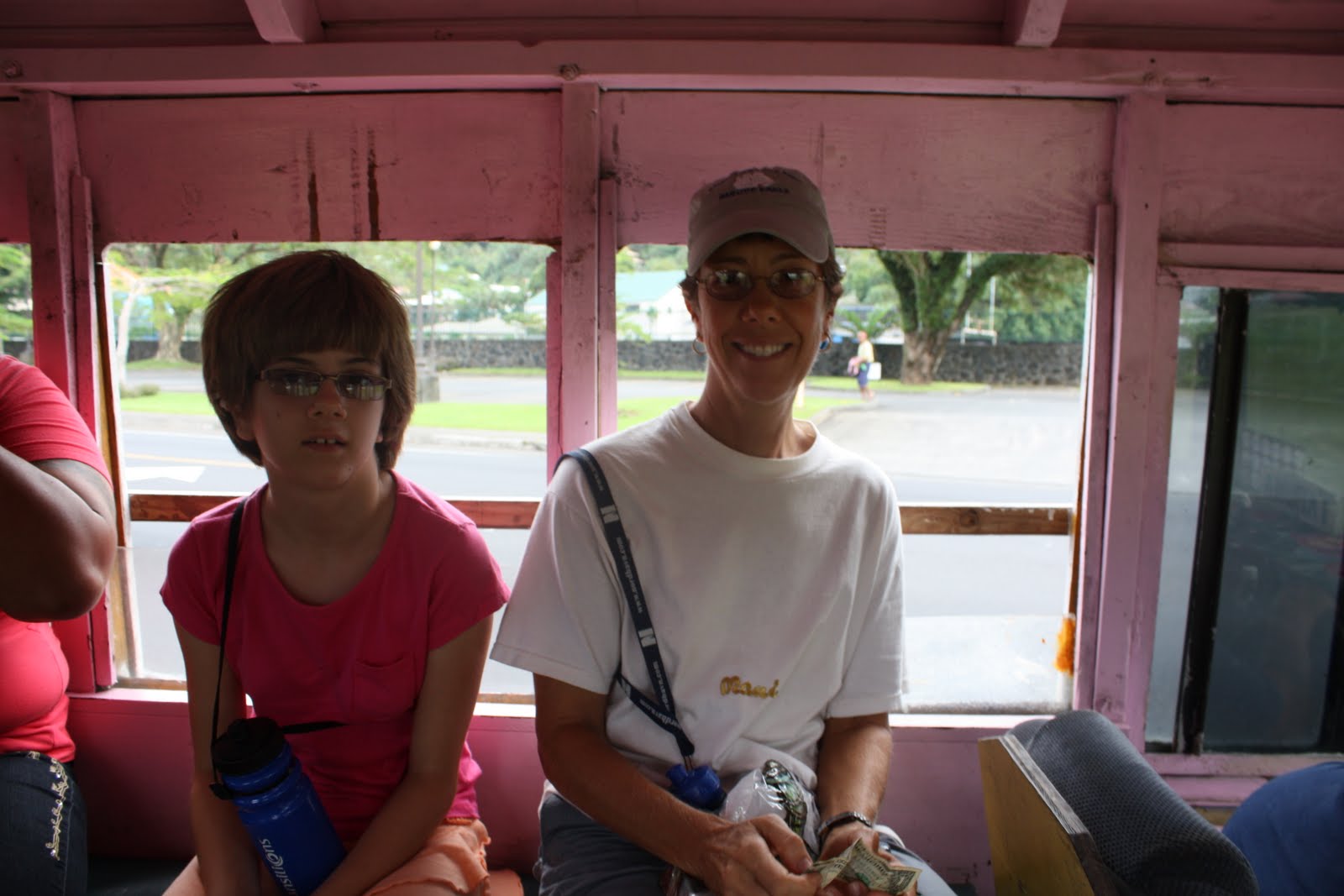
    It is simple and inexpensive to get around without a car.  There is a bus system that is efficient, colorful, and very user-friendly.  Each bus is privately owned, and each is a reflection of its owner.  The buses are built atop car bodies and the upper bus his made entirely of wood.  Each bus has a unique paint job on its outside, but the real personality emerges on the dash and area surrounding the driver.  Think of how some people personalize their work space with pictures, trinkets, and memorabilia.  Add feather boas, artificial flowers, and loud music, and you can imagine one of the more sedate buses.  They were wonderful!  And we never paid a fare over $1.

We met a Samoan family and they were very friendly.  Penitani (Benny) brought us free Papaya and gave Kim 6 natural white pearls he had found diving here.  Kim made his wife Lisa some earrings and Emily gave the children stuffed animals.  We agreed to deliver some food items to his parents in Tonga since they are much cheaper here.  He said they will give us a private tour in Tonga and we can’t wait to meet them.  He also has relatives in the islands of Niuatoputapu and Vava’u that we also will visit in the coming months.
Penitani, Lisa and kids
Jo rides for the first time


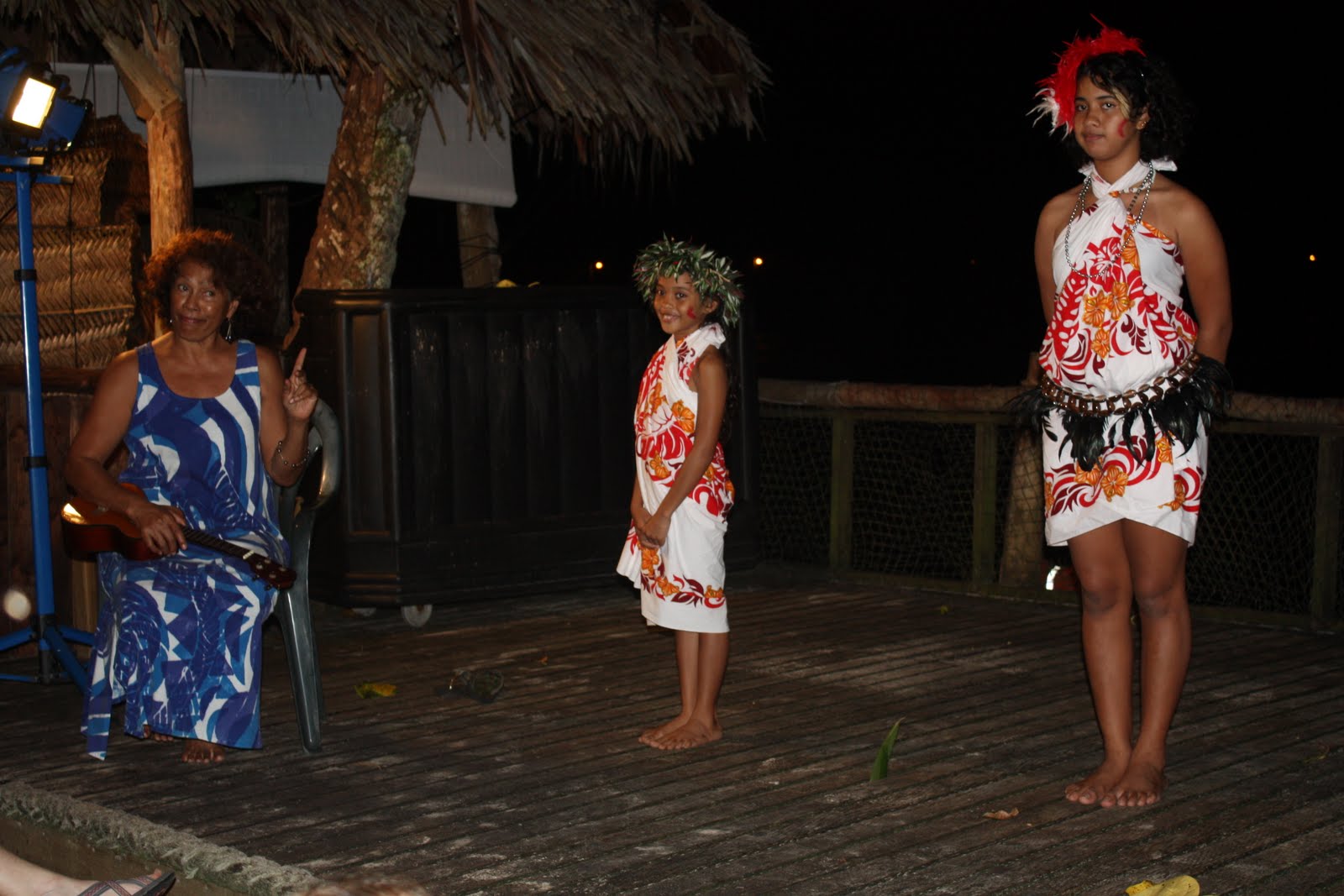
We went to a dinner one night at Tisa's Barefoot Bar that was nice.  We enjoyed a table right over the beach and were entertained by flying foxes...bats with a two foot wingspan.  Everything was cooked in a umu, the traditional Samoan oven.  They put all the food, (pig, turkey, New Zealand lamb, chickens, octopus, bread fruit, shrimp and vegetables directly on the rocks and cover it with big palm leaves.  The whole pile bakes/steams for three hours and we all ate family style with no utensils.  The pig and lamb fell off the bone and was mouthwatering.  Emily and I fought over the octopus and ate others portions of that too.  With full bellies we were entertained by some traditional Samoan dancing.  Unlike the Polynesian dance this was slower and more graceful and closer to the Hawaiian hula dance.

Liquids on top in coconut shells
Flying Fox


Tom

Thursday, July 29, 2010

Suwarrow

We had a bumpy 5-day passage to Suwarrow and almost did not leave when some air in the main engine had it running very rough. When bleeding the air, the vent plug broke in two pieces and luckily, I had a close match in my spares. We had a few engine surges along the way but she kept running. Using the SSB while underway, I e-mailed my engine guy, Bob Senter, and with only a promise of later money, agreed to have new parts waiting for my arrival in American Samoa.

The navigational charts were accurate for Suwarrow and we gratefully slipped into the calm anchorage and dropped the hook with 8 other boats. What a great place this is. Several of the boats have kids, so Emily is happy too.  While cleaning up the boat after the passage, the captain found a small Gecko clinging to the side of a fender.  Apparently he had stowed away and spent the last 5 days outside hanging on.  Since Emily had been begging to have a gecko on the boat (they eat flies and small bugs too) and this guy had already survived being at sea, I relented and it now lives aboard Emily Grace ...somewhere.

Our Stowaway

This isolated and uninhabited atoll in the Northern Cook Islands (located at 13°15'S, 163°06'W) has been for many years a favourite destination among sailors cruising the South Pacific. The man who put Suwarrow on the international cruising map was a New Zealander, Tom Neale, who, in the 1960s, lived on the atoll for six years. He described his Robinson Crusoe adventures in a book "An Island to Oneself" which inspired many sailors to visit this unique place. Tom Neale died in 1977, but inspired by his experience, the Cook Islands government declared Suwarrow a national park. Suwarrow is a major breeding ground for thousands of birds.
This Motu was where we hunted for crabs and had lunch
Baby Booby close enough to touch

Nowadays it's a popular spot for cruisers coming from Bora Bora, 680 miles away to the southeast. From Suwarrow to US Samoa is another 480 miles. The park ranger, James and his assistant, Appii (rhymes with Happy) could not have been nicer. There is a $50 dollar park fee, but compared to the high fees in the Southern Cooks and their confiscation of all Non-New Zealand meat, it was a bargain. Almost every day, they would take a group, spear fishing, snorkelling, scuba diving or fishing to several of the other atolls. James explained his interpretation of the Cook Island rules to us this way. Your frozen meat, beer and wine must also be confiscated here. However, rather than my taking it all at once, meat must be brought ashore each night and "burned" on their grill (and consumed) and spirits poured out slowly (into glasses). We can handle that interpretation!

The day we arrived, a group had gone "hunting" for Coconut crabs and a snorkel. They returned with a large sack of crabs and several fish they had caught while trolling along the way. The sea life here is abundant since it is so remote. The coconut crabs are land creatures and climb the trees and pick the coconuts from the tree. After they fall it can take them almost 1 week to peel away the husk and crack into the sweet meat. This diet gives their meat a little coconut flavour and it is quite good. The nine crews and rangers ate their fill and there was enough meat left over to make crab cakes the next day and feed everyone again.
Coconut Crab in the wild
James cooking on his custom grill
Nice Presentation by the Rangers-Enough for the whole anchorage!

The Suwarrow Yacht Club
Feeding black tip sharks the dinner scraps
Every 3 or four days, they repeat this hunt and we shared some gasoline with the rangers so that we could explore one of the atolls that was further away from the main anchorage. They have very limited gasoline from the Cooks government and rely on the cruisers for many of their supplies. The rangers had not yet visited this atoll, since they lack the gas to go that far. One morning we left in our dingy along with the rangers' aluminum boat and Oso Blancos' dingy for the 5 mile trip across the lagoon. It took almost 45 minutes to troll across this lagoon and it was exciting to explore another "deserted island". There were several round plastic floats (used by long-line fishermen and pearl farmers) that had washed ashore and the cruisers harvested any attached stainless steel hardware that we found. Tom gathered 3 nice hooks and swivels and we even found a new fender that had floated away from some previous cruiser. It took us little time to find the coconut crabs and we filled a sack quickly and walked all the way around the atoll. We also saw nesting booby birds and the fluffy white babies are always nice to see. We all sat on the shore and ate our lunch and then did some spear fishing.

Several of the guys had spear guns and it was exiting to watch them descend 30 to 40 feet while holding their breath for the attack. The added complication to spear fishing here are the sharks. There are numerous sharks inhabiting the lagoon and anchorage. The black-tipped sharks are little threat, but white-tipped and grey sharks are much more aggressive. After they spear the fish, it is a race to the surface since the bleeding, thrashing fish quickly brings in the sharks. The diver tries to hold the fish (still on the spear) out of the water while swimming back to the anchored dingy to drop off the fish. Off course, you can imagine the fish blood running down the hunters arm. My job, as a non-spear guy, was to watch and whack at the attacking sharks to discourage any loss of body parts.what fun! We got several grouper and parrot fish and headed back to the anchorage for yet another feast.


We have been here almost a week and are looking for a calm weather period for the 3-day trip to American Samoa. Cruising without a schedule is helpful. We have seen several boats head into really rough weather just to be somewhere at a pre-arranged time to pick up or drop off guests. It looks like strong winds and waves for the next 3 days, so we may be stuck in this paradise for a little while longer.

Tom
Posted via SSB

Friday, July 16, 2010

The Society Islands

After the PuddleJump party, we stayed in Mo'orea for a few more days. We swam with sting rays and black-tip reef sharks and enjoyed a tour of a juice factory. We sampled all of their drinks and even bought a few bottles of vanilla and pineapple liqueurs. While anchored in the harbors we had front row seats for the outrigger canoe races. They really move fast and the men have big muscles and even bigger tattoos!
These are the boats crossing this year.  Can you find Emily Grace on the T Shirt?

We motored overnight from Mo'orea (Mo-o-ray-a)to Huahine (who-a-hee-knee) and went into the main village of Fare. We were surprised to find a well-stocked grocery store and a good local market. They had strings of colorful parrot fish for sale hanging from the palm trees.

After a few days at the bigger northern island, we wound our way down the west side through coral heads to Huahine Iti for a few days. There we met a vacationing American who spends 4 months in Huahine every year (for the past 8 or so). He had a car and offered to take us inland to see a few sites. He obviously loves the culture and the people here. He speaks a good bit of Tahitian and French and seemed well known as we moved around. We saw fresh water eels that apparently arrived here with a storm about 400 years ago and are cared for by the locals. Emily got right into the water with these 6 foot long monsters. He showed us some fish traps that have been operating for about 800 years. The fish are carried into a labyrinth by the tides and the villagers collect them every day. Very simple but effective. We hiked up to see several more Marae and some outstanding views of the island.
800 year old fish traps

We went west to Riatea (Ree-a-tey-a) and Tahaa (Ta-a). We spent our 4th of July at the Taravana Yacht Club with several other boater friends and we had a barbecue on shore. We had hamburgers and watermelon but no fireworks. They also had a first rate restaurant and we enjoyed a nice lunch to celebrate Kim's 53rd birthday. We did some snorkeling around these two islands before slipping further west to Bora Bora. We stayed a few nights on a mooring at the Bora Bora Yacht club before anchoring on the west side of a small motu (island) called Toopua with our friends on Whiskers.

From there in Bora Bora, we sat on our floating home and watched a near total lunar eclipse as the sky went dark in mid-morning. Making more memories.

Several boats followed us to Bora Bora for the July 14th Bastille Day celebrations here. They had singing and dancing competitions each night and a nice parade through the town. Emily joined in the Bora Bora Yacht Club float dressed as a pirate. A private (BIG) powerboat put on a 25 minute fireworks display for his daughter one night that we all enjoyed.

Just as we were thinking of moving west again, we had a plastic part break on our watermaker. Since it was not in my spares and could not be fixed with epoxy, we are making arrangements to have the part shipped into American Samoa. After talking to the guy that installed it, I found out it was a known defect and they will ship the new part free. Of course, it may cost us more in shipping since we are out of the continental US! Spectra Watermakers gets a failing grade for not notifying its customers that this part was defective and might break. I would have rather fixed it at my convenience rather than worrying about running out of fresh water at sea!

Oh well. Cruising is fixing the boat in exotic places. Can't wait to see what is next to go.

Tom

Thursday, July 8, 2010

PuddleJump parties and Mo'orea

We started 3 days of PuddleJump parties on Friday night in downtown Papeete. Emily had a sail on an outrigger canoe and we picked up our free tee shirts and other information about the Society islands. About 70 boat crews were paraded through town behind several muscle-bound Tahitian drummers and we made our way to city hall. On the steps of this mansion, we had our group picture taken for Lattitude 38 magazine and we were led into a large meeting hall. We all received fragrant flower leis and were welcomed by the local officials. They had a wonderful buffet set up with breaded shrimp, chicken, fresh fruits, local salads and treats, crackers with caviar and beer, wine and sodas to drink. We were entertained by several troupes of dancers showcasing the dances we would see throughout the Society Islands. It was a memorable day.


The next day we all “raced” from Papeete to Mo’orea and anchored off a white sand beach. Some say that Mo'orea, which means 'yellow lizard', was the name of one of the island's ruling families, while others attribute this name to an image seen by a high priest while visiting the island.


Mo'orea was heavily populated before the Europeans arrived on its idyllic doorstep. Samuel Wallis was the first European to sight the island (1767), and he was soon followed by Louis-Antoine de Bougainville (1768) and James Cook (1769). The missionaries arrived on the scene in the early 1800s and made themselves at home, soon establishing their headquarters on the island. As elsewhere, European diseases and the introduction of weapons and alcohol had a disastrous effect on the population of Mo'orea, which continued to decline during the 19th century.


Copra and vanilla were crops important in the past but these days Mo'orea is the pineapple-growing centre of French Polynesia. Tourism is the other major industry.

For the next two days we enjoyed presentations, cook-outs and several Tahitian games. Emily won in the tug-of-war and did well in the banana carrying race and coconut opening contest. Daddy was winning the outrigger canoe race when 20 feet from the finish line, we flipped our six-man canoe! Apparently, those Tahitians are more careful than us Gringos. There was no damage other than to our dignity! We enjoyed more singing and dancers and saw our first fire dance which we all had been waiting for.


We stayed in Mo’orea for several more days relaxing with our friends on Whiskers. We strolled the beach and did some snorkeling before looking for some calm weather to make an overnight passage to Huahine. It sure does feel good to have most systems working good again.

Tom

Sunday, June 27, 2010

Tahiti


Papeete is a mere 200 miles from the tuamotus which is pretty short to get our new batteries and other things that were supposed to be waiting for us.  We anchored for the first night and then went into Marina Taina the next morning.  We had to med-moor, which means dropping your anchor and backing into the dock.  We did that pretty well but soon discovered that the 220 volts was not going to plug into our 110 volt system.  After a day of trying to find an electrician to build us a step-down transformer, we were pretty discouraged at the marina’s lack of empathy for our situation.  After a day and a half of not finding a French electrician that wanted to help, the dockmaster found another spot on another dock where we could share a marina transformer.  Another med-moor practice opportunity and we were finally settled in with the air conditioners humming.  Unfortunately, the marina transformer was tired and only reducing the voltage to about 150 volts.  The air conditioners and most things on my boat worked well with the higher voltage, but our icemaker stopped making ice and the inverter sensed the problem and shut down.

Despite the initial frustration, we started whittling away at projects and got most of them done.  Tahiti and the French decided to take this time to go on strike so my batteries got stuck in limbo until our last week and a few packages are still lost.

The stern of our boat was about 20 feet away from a restaurant and we had live entertainment while sitting on the boat.  One night we had front row seats for a Tahitian dance troupe.   One of the most widely recognised images of the islands is the world famous Tahitian dance. The ʻōteʻa, sometimes written as otea, is a traditional dance from Tahiti, where the dancers, standing in several rows, execute different figures. This dance, easily recognized by its "fast hip-shaking," and "grass skirts" is often confused with the Hawaiian hula, a generally slower more graceful dance which focuses more on the hands and story telling than the hips.  We enjoyed another version of the pig dance and some fine woman dancers trying desperately to shake off their grass skirts. 


One day we rented a car with the crew of Oso Blanco (Another Nordhavn with an 8 year old boy) and got a tour of the island.  In April 1769 Captain James Cook visited the island on secret orders from the Lords of the Admiralty to view the Transit of Venus on 2 June. He set up camp at Matavai Bay and stayed on until 9 August.  We saw the place where he landed and built his observatory.


We also saw a historical site called a 'marae'.  The marae we visited on Tahiti was actually the reconstructed version of the original that once stood on the same spot. There were giant stone statues in a rock-strewn field on the slope of a low hill, and where the hill leveled out there stood the marae. 


The islands each have their own marae design, but all have a very flat, rectangular, stage-like area as the focal point. The marae we saw also had wide pyramid-like steps on one end. Made from stone or coral, these meeting places served many functions. Small family marae were used for family events like births and deaths. Large marae hosted events such as village meetings and religious ceremonies. Sacrifices were also made on the marae, including human sacrifices from enemy villages. The name of the marae we visited was called Arahupahu, which in Tahitian means 'barbeque!

The list of famous authors who traveled to Tahiti and wrote about the island reads like a high-school literature course: Herman Melville, Robert Louis Stevenson, Pierre Loti, Rupert Brooke, Jack London, W. Somerset Maugham, Charles Nordhoff and James Norman Hall (the Americans who wrote Mutiny on the Bounty), among others. Exotic images of uninhibited dancers, fragrant flowers, and pagan gods fill the pages. 


The most unlikely PR man of them all was a once-obscure French painter named Paul Gauguin, who transformed the primitive color of Tahiti and the Marquesas into powerful visual images seen around the world. When WW II shook the Pacific from Pearl Harbor to Guadalcanal, rather than bloodcurdling banzais and saturation bombings, French Polynesia got a U.S. serviceman named James A. Michener, who added Bora Bora to the legend. Marlon Brando arrived in 1961 on one of the first jets to land on Tahiti and his Bounty film attracted thousands of other travellers and adventurers to also make the trip.


After 16 days at the dock, we were ready to get back cruising.  We timed our visit to take part in a 3-day party of “Puddle Jump” boats.  These are all boats working their way across the Pacific “Puddle”.  Stay tuned Dear reader and we’ll tell you all about it!


Tom